| |
August 1999 - Vol 1, No.
3 |
Products
and Services
2 Into
1 Exhaust - Another Perspective
By Dave
(NetX) Barber
Dave's Take on Roadhouse Pipes and
Daytona Pipes
The weekend of July 16-19, I had a
chance to travel to Kinston, NC for the recently held First Annual
Star-B-Que. Never, have I seen such a display of stars in all different
configurations. Many of the modifications were original and downright
ingenious. Of these, Jeff Henon produced some surprises in the aesthetics
of a truly original and classic motorcycle. One or two in which
I hope to steal...err, borrow.
Jeff and I had some pretty common ideas,
though we went about them in different ways. The most noticeable
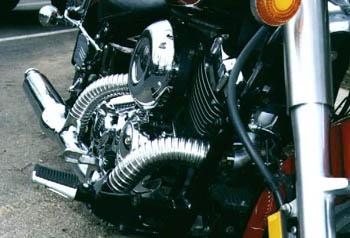
similarity was our exhaust pipes. Both of us opted for "2 into
1" exhaust with the Flex-O-Pipe look from the days of yore.
To achieve this look, you have on of three options. 1) Daytona;
2) Roadhouse; 3) Build your own.
I don't recommend building your own,
but I can absolutely recommend the first two options. Going with
Daytona or Roadhouse depends on your budget, your sound, and how
you plan on future modifications. Allow me to further explain.
Roadhouse
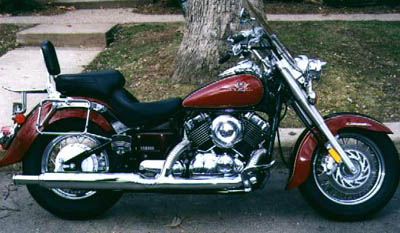
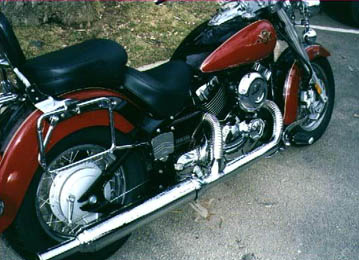
My bike has the Roadhouse
exhaust pipes, jetted with Baron's Big Air Kit (BAK) and Baron's
TorqueMaster rings. They are big and beefy with "2 1/4"
serrated stainless steel exhaust covers, which gives the bike a
more massive look. The rear canister is massive and the baffles
can easily be removed or replaced. What do you get for all this
"beefy-ness"? Sound. Not brash. Not loud, but a deep rumble
with mellow undertones. At idle, it just rumbles along at a fairly
quiet pace. Crack the throttle, and you are rewarded with the surprisingly
rapid response of growl and attitude. This is one setup where the
sound actually matches the "seat of the pants" feel.
Traveling down the back roads or highways
at a steady speed, you can definitely hear the rumblings, however
the sound is pleasant and rather quiet. Get the rpm's buzzing after
that, and those babies open up. Twist the throttle in any gear,
and they say, "Watch out, I'm coming through!" The odd
thing is, they really don't appear to overly loud, which is a tremendous
asset for those of us who like our hearing and don't wish to annoy
the neighbors.
For protection of your investment,
Roadhouse explains, "the sixteen gauge header pipe construction
is thermal aluminum ceramic coated; reducing header pipe temperature
by up to 20%, which helps reduce pipe finish discoloration."
My experience is, with properly jetted carbs, these pipes stand
up to heat very well against discoloration. However, if you don't
rejet with the pipe installation, they will quickly turn gold. I
suggest getting everything done at once.
There are some considerations in owning
the Roadhouse pipes. Though they look fantastic, sound good and
come complete; they are pricey. Complete setup is $569.95. This
includes all the gaskets, replacement chromed brake rod and right
foot peg relocation extension, which relocates the right foot about
1 1/2 inches outside. This sounds like a considerable distance,
but in reality, it's not even noticeable.
What does this mean? Well, for starters,
forget adding on Engine guards, forward controls or Extended pegs,
unless you manufacture them yourself or modify aftermarket ones.
However, they do not interfere with custom peg or floorboard setup.
Daytona Impressions:
Though smaller in stature, Jeff's Daytona exhaust produced a remarkably
sharp sound, with a very pronounced staccato cadence. When the bike
is first started in a group of other bikes, there is no mistaken
whether the engine is running or not. Riding behind the bike is
not an offensive experience, though the exhaust is clearly audible
from ahead. Laying on the throttle or going uphill produces a definite
aggressive sound, and yes... loud!
In essence, I really liked the Daytona's
aesthetics and recognize their value. There is less apparent hassle
involved in installation. However, the Roadhouse pipes have just
the mixture of aggressive growl and low bass mellowness I need for
everyday riding; and "twist the wick" barking for when
I really get playful.
Either way, you really can't go wrong.
|