|
A Ride
Down Memory Lane
By Brad (DangerMouse)
Joyce
The Indian Four was the ultimate in
luxury cruising in its day. Its four-cylinder engine was technically
complex, yet incredibly smooth. It’s graceful bodywork spoke
more of quiet elegance than loud braggadocio. It was somehow a more
equine machine than its competition.
When Yamaha introduced the Royal Star, a technically complex, smooth
running four-cylinder, elegant luxury cruiser, it was as is if a
baton were being passed from the old generation to the new. It was
the first machine from Japan that attempted to compete with Harley-Davidson.
They weren’t trying to ape the big HD’s like Kawasaki
and Honda had tried, making bikes that had the look but not the
feel. Yamaha instead created a genuine alternative. The introduction
of the V Star was the rebirth of the Scout. The Road Star resurrected
the Chief.
I frequent antique motorcycle shows
to seek out these stepfathers of the Stars. I examine them carefully
to try to unlock the mystery of Springfield’s finest. I look
for ideas to apply to my own Star. But most of all, I just ogle
the damn things!
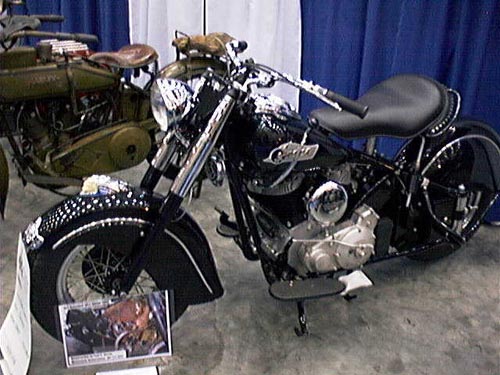
This is a Blackhawk Chief. It is
one of the last Indians to come from the plant in Springfield affectionately
known as ‘The Wigwam’. Note the hydraulic forks, the
Indian Head Mascot light on the fender, the fully valenced fender,
and the ‘chum-me’ saddle. This is one of the most highly
sought after bikes in the antique market. Very few Blackhawks were
produced. This finely restored example is from the early 1950s.
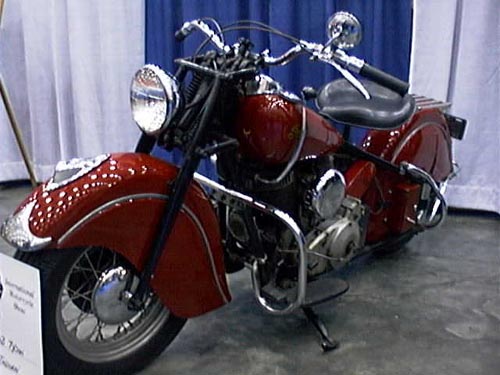
This is an early 1940s Scout. Unsure
if the valenced fenders would appeal to a large audience, they were
offered as an option in 1940. Note that the front fender is even
more full than the Blackhawk above. Chrome is very tastefully restricted.
Note the front suspension. This may be one of the prettiest solutions
a Motorcycle engineer ever devised to eat up bumps in the road.
This model may just be my favorite Indian.
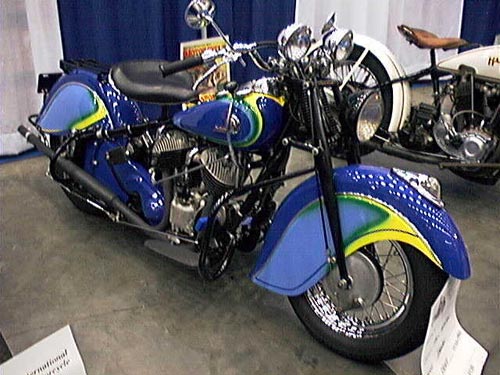
Can you imagine that paint like this
was available from the factory? This specific model has a layer
of recent paint, but it is not an uncommon theme. When DuPont bought
the Indian Motocycle Company, they were able to utilize their extensive
experience with paint to offer some of the industry’s most
interesting schemes ever offered. These were called rainbow finishes.
Many restorers recreate this look. Original paint like this is highly
sought after.
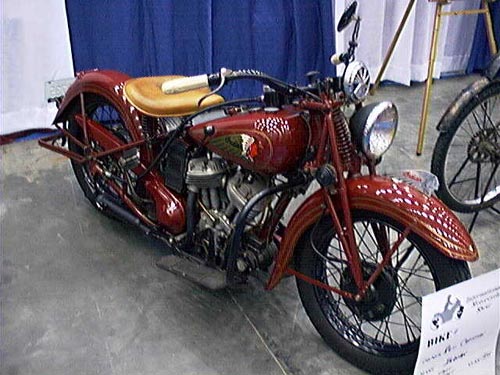
Ahh, the Scout 101. There are still
to this day active clubs for this bike. Even though the bike is
nearly 70 years old, something insane like 65% of them are still
on the road. For it’s time it is considered to be by many
the finest motorcycle ever produced. What a gem of a restoration,
too! It’s graceful lines are somehow still beautiful today.
I was very pleasantly surprised to see such a fine example.
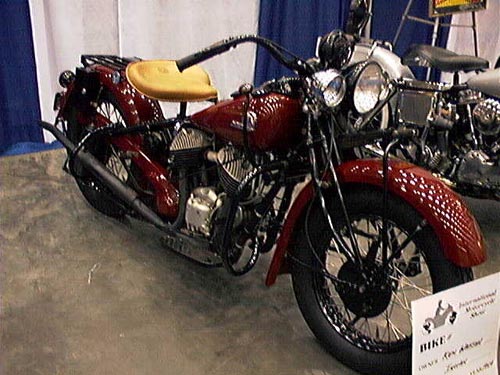
This is Indian’s mighty Chief
before the valenced fenders of the 1940s. Note the leaf-spring front
suspension. This type of suspension was used all the way through
the 30s. Indian designers felt that chrome was gaudy if over used.
This incredible restoration retains the blacked out wheels, forks,
and handlebars of the original. Customizers looking to out-Arlen-Ness
each other could learn a thing or two from the understated elegance
of black chrome.
In my opinion, psychiatrists could use this bike to determine if
their patients are sane. I’m afraid that if the utter beauty
of this visually striking machine does not move you, you may belong
on a Honda standard. The wide whites, the brown leather, the rich
two-tone paint, the generous yet tasteful chrome – it all
adds up to classic beauty. I think I’m in love. This bike
was near the stage at the bike show where a bikini contest was being
held. I honestly can’t tell you who won. |