| |
December 2003 - Vol 5, No.
2 |
Maximize Accuracy During
Carb Synchronizing
The Problem
Synchronizing the carburetors of the
V Star 1100 requires special tools and precise adjustment of the
synchronizing screw. To simplify this process, some have advocated
running a vacuum line from the intake manifold on the front cylinder
to the compartment that holds the tool bag. This compartment already
has a vacuum line from the intake manifold on the rear cylinder
to the AIS (air-induction system) or, on motorcycles that have the
AIS removed, a vacuum line that is terminated in the compartment.
This creates a very convenient spot for hooking up a carburetor
synchronizer.
However, as shown in Figure 1, the
vacuum line from the rear-cylinder intake manifold to the AIS includes
a part called a "nozzle." This part comes with all V Stars
(Classic, Custom, and Silverado) from 2000 to 2004. If a synchronizer
is connected to the lines in the tool-bag compartment, will this
nozzle affect the reading?

Figure 1. Callout of "NOZZLE"
in Exploded View of AIS
The Experiment
I tested the carburetor synchronization
using a Twinmax in four conditions:
1. No restrictors used; Twinmax connected
directly to the intake manifolds.
2. No restrictors used; Twinmax connected
to the ends of the two vacuum lines.
3. Restrictors used; Twinmax connected
directly to the intake manifolds.
4. Restrictors used; Twinmax connected
to the ends of the two vacuum lines.
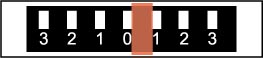
As shown in Figure 2, the readout on
the Twinmax is a needle that indicates an imbalance by registering
on either side of zero. I hooked the vacuum of the front cylinder
to side A and the vacuum of the rear cylinder to side B. In each
of the four experimental conditions, I let the motorcycle idle at
about 1000 RPM and took a reading from the Twinmax. Differences
between conditions where the vacuum lines were used and where the
vacuum lines were not used indicate that the nozzle interferes with
the reading. The results are shown in Table 1. Note that the red-tinted
area indicates the needle reading, which fluctuated at engine idle
from left to right.
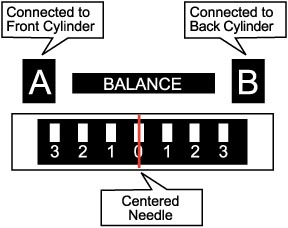
Figure 2. Readout of Twinmax
Table 1. Results of Experiment
|
Restrictors Used
|
Vacuum Lines Used
|
Twinmax Reading
|
| 1 |
NO |
NO |
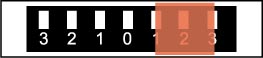 |
| 2 |
NO |
YES |
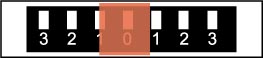 |
| 3 |
YES |
NO |
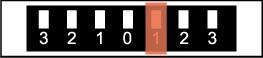 |
| 4 |
YES |
YES |
 |
Conclusions
The restrictors reduced the needle
swing, so I highly recommend using them to take readings. There
was a slight difference between the line and no-line conditions,
so I recommend taking the reading directly at the intake manifolds
for more precision. It appears that the nozzle does affect the reading,
if only slightly. Another option is to purchase a nozzle and install
it in the vacuum line from the front cylinder.
|