| |
April 2004 - Vol 6, No.
2 |
Planning
a Road Trip
By Stephen
Fishman, ISRA #1948
On a motorcycle, mountains look higher
and drop-offs seem steeper; aromas are more pleasant while foul
odors are more pungent; and twisty, winding roads are something
to look forward to.
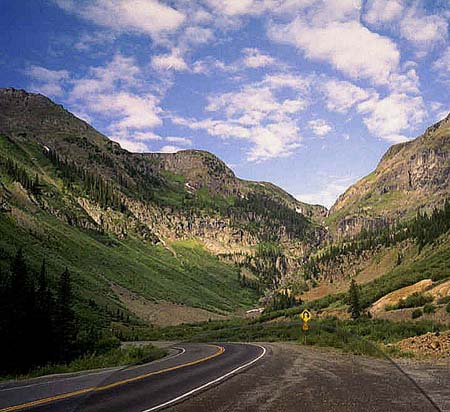
Figure 1: Mountain Valley
There are more contingencies to prepare
for than a trip by car, but there's less room to pack for them.
Even the biggest saddlebags and trunks limit what you can take.
Maps
Local bookstores probably have the
maps you need, but every state has a Web site. The cheapest way
to collect the maps you need is to request them from each state's
department of tourism. They often send a complete package with information
about lodging, points of interest, seasonal events, and so forth,
and they'll even pay the postage!
Roads
For most riders, an enjoyable road
trip is confined to secondary roads that can include four-lane divided
highways, cracked two lane asphalt narrowed to one lane by encroaching
sand and scrub, winding mountain roads and a blacktop flanked by
a bayou and a swamp. It takes a lot longer to navigate switchbacks
through mountains than it does to fly down sweeping curves in a
wide, flat valley, but each route offers its own charm.
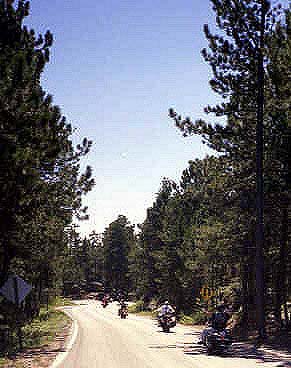
Figure 2: Iron Mountain Road in the Black Hills
Fuel
As towns shrink in size and frequency,
so do the opportunities to fill up. With the exception of touring
bikes, most motorcycles have a range of about 140 miles per tank,
or less. If your travels take you through the American west, you'll
discover early on that the distances between towns increase quickly.
You might even consider taking along a one-gallon plastic gas can
if you expect to cross vast expanses of open country.
Food
Likewise, give some thought to where
your next meal will come from. Restaurants serving a small local
population usually close early, like this diner on old Route 66.
We arrived for a late lunch at 2:00PM just before they closed.
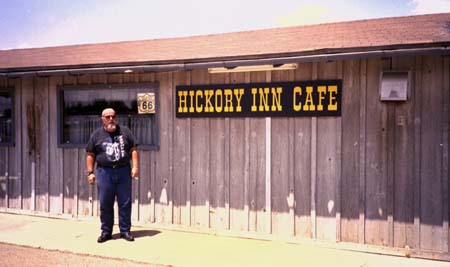
Figure 3: Small Town Restaurant
Take along snacks. Not everyone is
ready for a meal at the same time, and the larger your group, the
more this is true. Riding for several hours on twisting mountain
roads is exhilarating, but it burns up the calories.
Overnight
Many riders feel that dealing with
whatever accommodations they find along the way is part of the experience,
but this is a group decision. If the weather cooperates and you're
carrying the right gear, camping might be an option.
Something else to consider is that
small towns on a map may not really be towns at all. Very small
towns can become deserted or disappear in as little as a few years.
Many "towns" can turn out to be nothing more than wide
places in the road. Making advance room reservations is often a
good idea.
Solo or in a Group?
I'm not a social creature by nature,
but I've found I enjoy the motorcycling experience more fully when
I share it with others. Group riding is less flexible than traveling
alone, but I would recommend traveling with at least one other rider,
for several reasons:
- It enriches the experience, and it can bring
good friends closer.
- Exuberance and enthusiasm are contagious. There
will almost certainly be small disasters and delays along the
way, and another rider or two can help you laugh instead of getting
upset.
- There is visibility and safety in numbers.
- If a breakdown occurs, another rider an help
with tools and repairs.
Traveling Companions
In my experience, there are three types
of riders: the iron-butt, the tourist, and the traveler. The iron-butt
rider is so focused on the destination that he forgets that a bike
trip is, first and foremost, a journey.
The tourist wants to see as many sights
as possible. You may not get far each day, but you'll come back
with stories, memories, and pictures that will be unmatched by the
rider who is blind to what lies beyond the highway.
The traveler tends to go along with
either type. This type is content to see what he or she can from
the comfort of the saddle, but can easily be convinced to take a
side trip. I'm a traveler. I don't make a lot of side trips, but
the ones I do make generally include the bike. On an extended trip
to Sturgis, my friend, Don, and I saw Mesa Verde and Four Corners
on the way up, Mt. Rushmore and the Crazy Horse Monument on a day
trip at the rally, and Pike's Peak and the Garden of the Gods on
the way back.
Miles per Day
This goal drives everything else once
you leave home, but the mix of rider types impacts this expectation.
If your group consists of iron-butts, you might cover 600 miles
a day or more, but 300 miles a day might be a stretch if your group
is comprised primarily of tourists.
When possible, confine your travels
to daylight hours for safety as well as enjoyment. Secondary roads
run through forests and open ranges where the deer and the antelope
play. You won't encounter Bambi on the interstate, but if you're
running down a two-lane road through forested country after dark,
the chances are pretty good you'll have a close encounter with a
beautiful buck.
Sightseeing
Sightseeing will reduce your daily
progress faster than anything else. Plan interesting stops along
your route and allow for unplanned side trips, and be content that
these travel days will be short on mileage but long on enjoyment.
Weather
Don't expect perfect weather every
day. It may work out that way, but it's the exception and not the
rule. Your itinerary should allow for weather delays, even if all
it means is reducing your speed.
August is the rainy season in the mountains,
which means it's guaranteed to rain every afternoon. To be sure,
it isn't as much fun as riding in brilliant sunshine and dry roads,
but you can still have a great ride.
What to Take
A motorcycle has limited real estate
for clothing, toiletries, spare parts, and tools, but with a little
planning, you can equip yourself for changing weather and minor
mechanical problems.
Luggage
If you're making a day trip to the
beach, you can probably pack everything you'll need into a small
duffle. But an extended trip calls for as much luggage as your bike
can hold.
If you don't own saddlebags, purchase
the largest set that will fit your bike, and add a tailbag. Luggage
doesn't have to be expensive to work well and hold a lot of gear,
and you simply can't have too much storage space. When full, it
may feel as if you've got a small passenger sitting behind you.
On our trip, we both already had roomy
saddlebags, so we each added an expandable tailbag strapped to the
backrest and fastened a toolbag across the forks. Since we were
planning to do some camping, we each carried a sleeping bag and
a small soft-sided cooler, and I carried a tent.
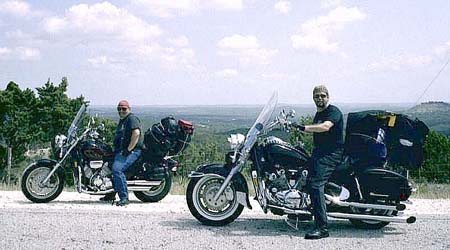
Figure 4: Our Packed-Down Rides
Clothing
There is an old adage about packing
for a trip: take along half the clothes and twice the money. This
is good advice, but the clothing you take depends to a great extent
on the time of year and your route.
Summertime temperatures in Texas can
average 95 degrees plus, and the New Mexico desert was even hotter.
In the mountains of Colorado we climbed to altitudes of 10,000 feet
and higher, and that meant temperatures in the 40s. We packed full
winter riding gear alongside T-shirts and took some in-between duds,
too.
We each dedicated one saddlebag for
leathers and rain gear, which made it easier to gear up and down
as the weather changed.
Tools
Every rider has a different attitude
towards repair and maintenance, and taking along tools you don't
use at home can only get you into trouble. Zippered tool kits are
great, such as those from Cruz Tools, but you can also assemble
"kits" from your own toolbox. My tool assortment includes:
- Mechanical: crescent wrench, small locking pliers,
screwdrivers, Allen wrenches, a penlight, and a pocketknife.
- Electrical: wire cutters, terminals, electrical
tape, heat shrink tubing, and lengths of 14-gauge insulated wire.
- Miscellaneous: nylon zip ties, corrosion block,
shock cords, duct tape, clean rags, earplugs, tire gauge, and
spare ignition key.
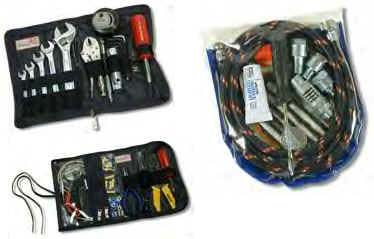
Figure 5: Cruz Tools Kits
There's not much you can do about the
way your engine runs when you're climbing up and down mountain passes.
The air is thin at 10,000 feet, and your engine loses 3% of its
power for each 1,000 feet you climb above "normal." Since
I live at sea level, my bike lost about a third of its horsepower
by the time we reached the top of each pass. One of the ways to
combat this problem is to use the lowest possible grade of fuel.
There's a good reason why service stations at altitude sell 82-octane
gas.
Miscellaneous Stuff
What this means to you depends on where
you're headed. We intended to camp, so we packed bug repellent,
but lip balm and sunscreen are a must, as are diapers and Windex.
If you take a camera, bring plenty of film and batteries. You might
stash a small notebook if you're the type who likes to write, as
well as binoculars, an extra pair of sunglasses, and, if you use
them, reading glasses.
Though not required, we packed helmets
for rain days and to prevent the Texas and New Mexico desert sun
from cooking our brains.
For the Folks Back Home
While you're watching the world go
by, take a moment here and there to record in pictures and notes
what you see for the unfortunate folks you left behind.
Landscapes on an open highway can be
breathtaking, and scenic turnouts along mountain roads are often
spectacular. Planning for these short stops reduces the number of
miles you can put behind you each day, but when you get back home
you'll congratulate yourself every time you look at your pictures.
While you're stopped, jot down a few notes about where you are and
what you see; the log will help jog your memory.
Last, but Not Least…
Don't fill your bags to the top before
you leave home. You'll want T-shirts and souvenirs along the way,
and the bags will be full by the time you get home.
Take extra cash. Side trips often have
an entry fee, and it's a sure bet you'll encounter unexpected expenses.
In addition to the entry fees, food is expensive, and there are
additional activities once you're there.
Your first long trip might be months
in the planning, but it will be over before you know it. Is all
the planning worth it? Absolutely! And chances are you'll be planning
your next trip even before you get home. |